
WMIF MAIN SITE
2027 Event Site
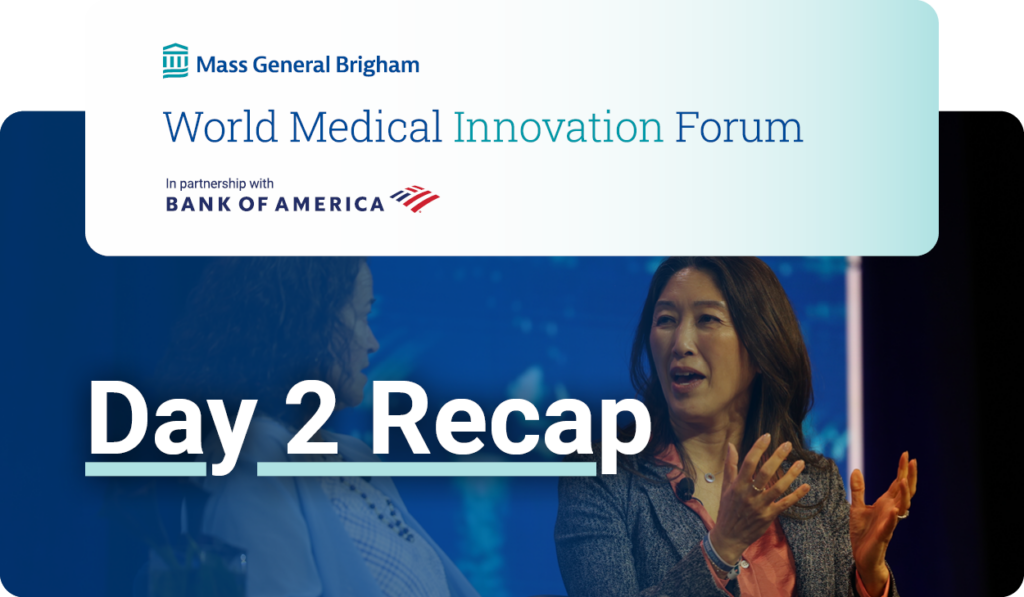
If Day 1 asked what innovation can make possible, Day 2 returned again and again to what it takes to reach the patients who need it.
On Day 1, Mass General Brigham Harvard innovators delivered First Look rapid-fire presentations on breakthrough technologies, scored by a panel of Bank of America judges on translational and commercial potential.
Miceal Chamberlain, President of Massachusetts at Bank of America, presented the winners, noting that the investigators offered a comprehensive view of the latest breakthroughs with high-impact commercial potential, and that the winning research addresses an unmet need with strong scientific and collaboration potential that will impact patient care.
Lloyd Bod PhD was recognized for cytagonists, which restore the immune response in pancreatic cancer patients whose own antibodies are shutting it down. Roughly half of patients with poorer outcomes fall into that group, and the approach could extend to other cancers and to autoimmune, inflammatory and infectious disease.
Korkut Uygun PhD was recognized for precision freezing, which preserves an organ for weeks to months rather than the hours it survives on ice. For patients, that means a transplant could reach them wherever and whenever they need it, rather than being lost to the clock.
Oben Health won the 2026 Kraft Prize for Excellence and Innovation in Community Health, ahead of nearly 250 applications across more than 45 states and territories. The AI-enabled platform transforms barbershops and beauty salons into trusted health screening hubs, reducing negative outcomes from heart disease.
Robert Kraft made the award and on behalf of the Kraft Center for Community Health at Mass General Brigham.
“One great idea can improve thousands of lives.”
Robert Kraft
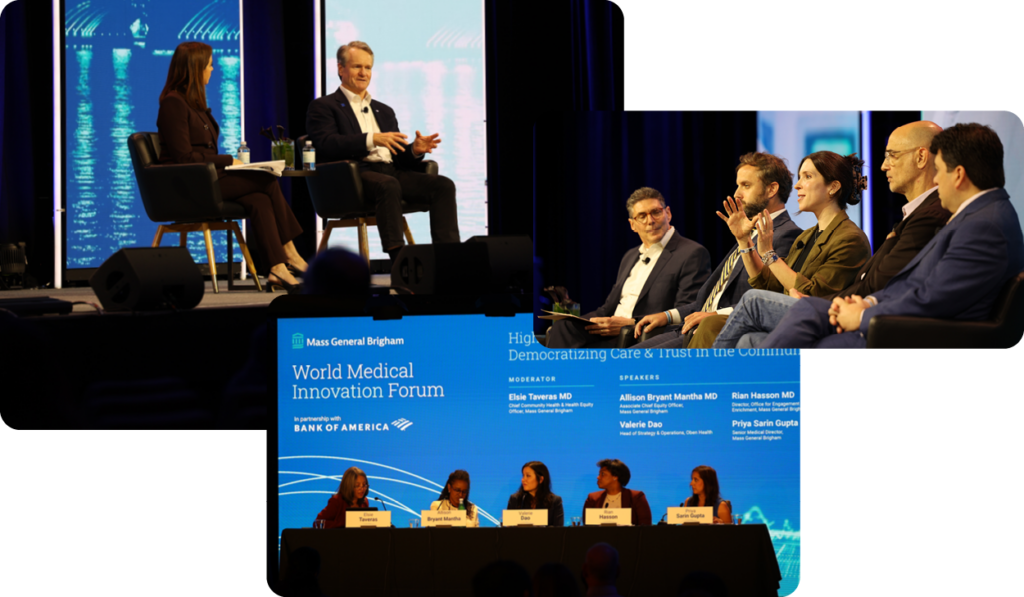
Julie Kim, in her first months as CEO of Takeda, joined Merit Cudkowicz MD to discuss new medicines for polycythemia vera and narcolepsy type 1 emerging from the pipeline. She traced the orexin program back fifteen years, through a molecule that worked but required continuous infusion and a second that carried a safety signal, to an oral treatment now approved in the US, Japan and China.
Investor Perspectives in Biotech described a market finding its footing again, with 21 companies public this year against 11 the year before, and a discipline learned from the overcapitalization that followed 2020 and 2021.
“Takeda has been around for 245 years. My responsibility is to make sure that Takeda is around for another 245 or so years.”
Julie Kim, CEO, Takeda
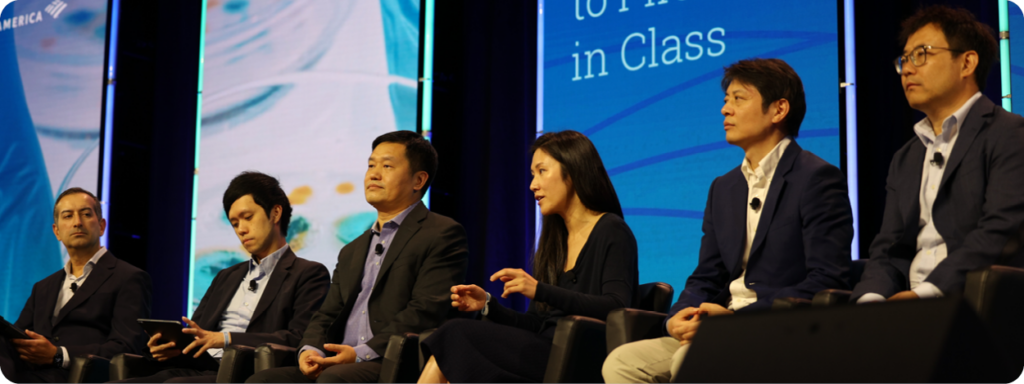
China biotech leaders described the Chinese government’s five-year plan’s goal that a quarter of newly approved drug molecules to be first in class from China by 2030. Panelists traced the shift to regulatory reform, the opening of pre-revenue listing on the Hong Kong Exchange, and a capital cycle that forced companies to sharpen their pipelines.
In American Academic Medicine’s Global Reach, health system leaders from Cedars Sinai, Cleveland Clinic, and Mass General Brigham described an evolving model of building expertise locally through partnerships ranging from facility development in the UAE to a wholly owned London clinic.
“There is a lot of strengths in the West and strengths in the East, and it should really just be a partnership.”
Judith Li, Partner, Lilly Asia Ventures
In High-Tech, High-Touch, No Walls, panelists described bringing care to where patients live, across maternal health, hypertension, lung cancer screening and substance use disorder. Mobile clinics offer naloxone, wound care and testing without requiring a hospital visit first.
Tech-Enabled Care Delivery traced why proven academic care models needed new companies to reach more patients. The obstacle was rarely the clinical model. It was incentives, workforce shortages and payment structures that treated prevention as a loss.
Across both conversations, the same boundary held: technology should support the relationship, not replace it.
The Darwin Factor found the clearest traction in AI tools that save clinicians time without asking them to change behavior, while Whiteboarding the Future of the HC Enterprise drew a related lesson from banking and consumer goods: replacing one task with AI rarely transforms a process by itself.
Affordability & Financing of High-Cost Curative Therapies followed the same question into the economics of cures, where hospitals may often build specialized infrastructure without knowing how many patients they will treat or when they will be paid. Affordability, the panel concluded, is an ecosystem problem.
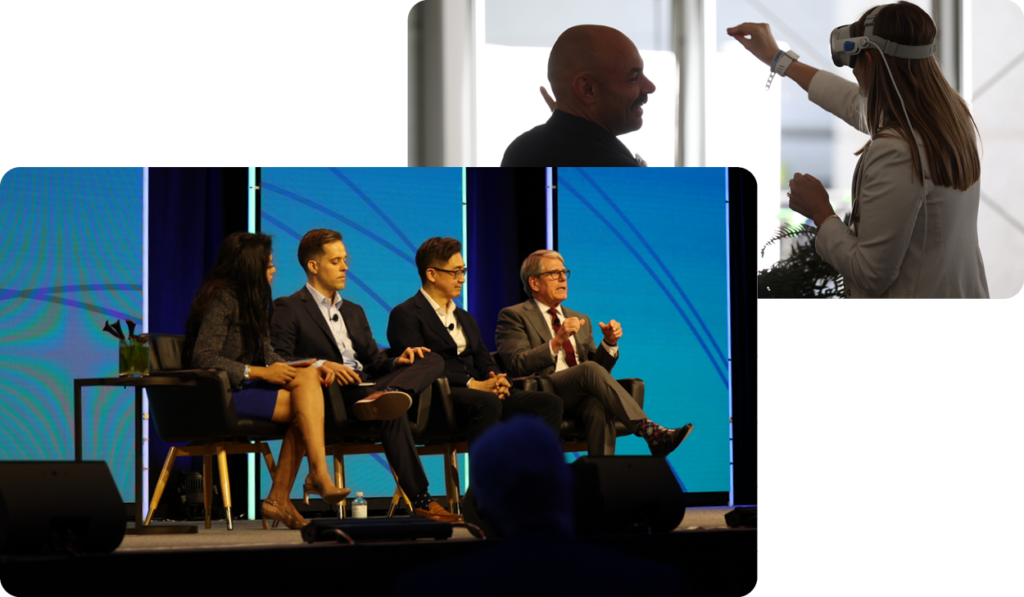
Beyond the First Wave examined what the first generation of cell and gene therapies taught the field, from the cost and conditioning autologous approaches require to the timing problem in neurological disease, where correcting a mutation may come too late once tissue injury is irreversible.
In Unbreakable Tumors? Not Anymore, panelists traced oncology’s successive waves from chemotherapy through immunotherapy to precision approaches, including a recently approved RAS-targeted molecule for pancreatic cancer, a target considered undruggable for four decades.
“The periodicity of these waves has gotten shorter, and a lot of these are starting to overlap.”
Roy Baynes MD, PhD, CMO, Eikon
Mass General Brigham and Bank of America are proud to present the World Medical Innovation Forum with its enduring benefit to patients.
Thank you to Astellas and Genentech at the Champion level, and to Accenture, AstraZeneca, Canon, Philips, and Siemens Healthineers at the Strategic level, with Ozlo, Quarles, Thermo Fisher, and United Imaging at the Collaborator level, for supporting the 2026 Forum. Many thanks to the teams at BofA and Mass General Brigham who spent 14 months building every aspect of the event and the Steering Committee who guided the content.
The World Medical Innovation Forum returns September 21–22, 2027 at Encore Boston Harbor. We look forward to seeing you in Boston. Register Now for 2027.

© 2026 Mass General Brigham Incorporated. All Rights Reserved
We use cookies to improve your browsing experience, analyze website traffic, and personalize content. By clicking “Accept All” you consent to our use of cookies. You can manage your preferences at any time. See our Privacy Policy.
We use cookies to run this site and, with your permission, to analyze traffic and personalize content. Choose which cookies to allow. See our Privacy Policy.
Required for the website to work. Always active.
Lets us measure website traffic and personalize content through Google Analytics. Nothing loads until you allow it.