


WMIF MAIN SITE
2026 Event Site
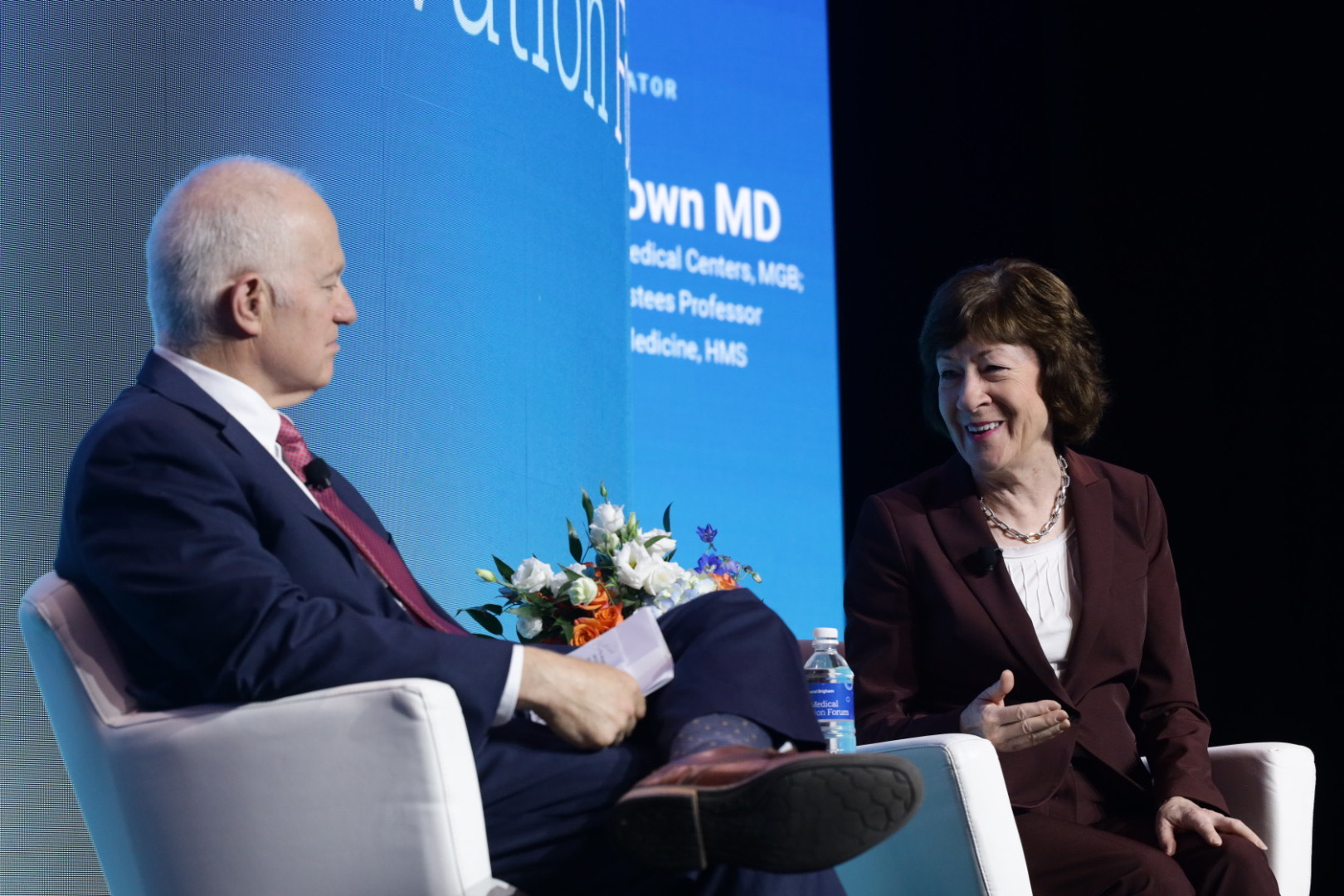
The Forum’s first morning spotlighted the intersection of science, care delivery, and federal policy through three conversations with leaders shaping today’s health landscape.
Fireside Chat with Senator Susan Collins
Senator Susan Collins, Maine’s senior Member of Congress and Chair of the Senate Appropriations Committee, joined David Brown, MD, MGB President of Academic Medical Centers, to discuss federal investment in biomedical research.
“Young researchers and scientists are wondering, is there a place for them in America? Are they going to be able to pursue the research that motivates them, that inspires them, or are they going to have to go elsewhere?” -Susan Collins, (R-ME)
She reaffirmed her strong commitment to NIH funding, stressed the importance of addressing health disparities, and warned of the impact Medicaid cuts could have on rural hospitals and vulnerable patients. She also emphasized the importance of compromise in today’s political environment.
Watch Fireside Chat with Susan Collins.
Policy, Congress, and the FDA
MGB Heart and Vascular Institute head Patrick Ellinor MD, PhD, moderated a discussion with Larry Bucshon, MD, Senior Policy Advisor at Holland & Knight and former U.S. Representative from Indiana and Robert Califf MD, Instructor in Medicine at Duke University and former FDA Commissioner. They acknowledged the erosion of public trust in science but pointed to ways forward, from stronger patient-provider connections to better public education. Both highlighted opportunities to secure the drug supply by investing in U.S. manufacturing and smarter purchasing systems.
Watch Fireside Panel: Policy, Congress, FDA

Early Perspectives on New Directions for Medicare
BGR Principal Remy Brim PhD, spoke with Chris Klomp, Director of Medicare at CMS, about the future of the program. Klomp outlined priorities for modernizing data systems, ensuring technology adoption improves patient care, and shifting payment models to reward value rather than volume.
“If there’s one topic in the federal government that should be the great unifier, it is in fact health care, because incontrovertibly it doesn’t matter if you’re red, blue, left, right, it does not matter. The following statement is true in both sides… We are less healthy as a country than we have ever been in our nation’s history, and we are spending more money on health care than we have ever spent.” – Chris Klomp, Director of Medicare and Deputy Administrator, CMS
Watch Fireside Chat: Early Perspectives on New Directions for Medicare
Robert Kraft announced the inaugural winner of the Kraft Prize for Excellence and Innovation in Community Health: ThriveLink, a St. Louis–based telephonic AI solution that helps families enroll in safety-net programs like health insurance, food stamps, and utility assistance. Founder and CEO Kwamane Liddell joined the subsequent panel discussion on innovative solutions to community health.
A panel moderated by Atlas Venture’s JF Formela MD and including including MGB Executive Vice President, O’Neil Britton MD and CEO of United Imaging Healthcare North America, Jeffrey Bundy PhD discussed how health systems, economies, and care models need to evolve to address the older population’s growing demands.
“Everyone talks about the silver tsunami coming. We are waist deep in it right now.” – Kris Engskov, CEO, Rippl Care
Led by McKinsey’s Anu Madgavar, panelists discussed a notable gap in caring for an aging population and the importance of investing in the quality of care and caregivers. For diseases like dementia, our health care system is at risk of being overwhelmed quickly by the growing number of older Americans seeking care. In rural areas some are waiting several months to be seen by a physician and refuse or are unable to travel outside of their community to be seen due to transportation and cost limitations. Despite growing challenges, the emergence of AI and automation offer potential modern solutions and expansion of healthcare access to elderly people in need.
Watch Silver Tsunami – Unprecedented, Unaffordable, Unceasing
Co-Director of the Neurological Clinical Research Institute at Mass General, Sabrina Paganoni MD, PhD joined panelists, including Paralympian Cheri Blauwet MD, author and advocate Lily Collison, and others to discuss ground-breaking mobility technologies and how they’re transforming what’s possible for people with disabilities, improving quality of life, and creating a more inclusive world. Panelists discussed the technologies developing and how to make high-quality mobility equipment more accessible domestically and globally.
“There’s a generation out there born before civil rights for those with disabilities… Now we have what we call the ADA generation and they’re at the front door of work demanding more from their employers and more from technology.” -Regina Kline, Founder and Managing Partner, Enable Ventures
The WHO estimates 1.3 billion people worldwide have a significant disability. Panelists emphasized the importance of sophisticated technologies born with the focus of helping people with disabilities, including the ability to connect the brain to bionic limbs. These technologies could advance further as leaders in biomechatronics with disabilities themselves emerge.
“Too many of our technologies degrade who we are. They’re not good for our minds. They’re not good for our bodies. My wish is we see a revolution in design, where we ask the question, how do we have technology truly serve humanity?” Hugh Herr PhD, Professor, MIT Media Lab Biomechatronics Group
Watch Innovation in Disability Technology | Shaping a More Accessible Future
Moderator Rishi Singh MD, Chair of Ophthalmology at Mass General Brigham, led a dynamic discussion with panelists for the Saving Vision session, while representing a variety of specialties including glaucoma, diseases of the retina and cornea, and hereditary eye conditions, all expressed common interests in advancing innovation faster and personalizing care wherever possible. The panel cited improved data and AI capabilities, successful cell and gene therapies, advances in micro-surgery, stem cell transplantation, and the explosion of biologics as among the most promising breakthroughs. Although cost, scalability and lengthy regulatory cycles remain challenging, exciting next-gen therapies are on the horizon. These include the ability to risk-stratify patients and use that data to customize associated treatment plans.

© 2026 Mass General Brigham Incorporated. All Rights Reserved
